- 05/05/2026
- 6 Min Read
- By: Christian Schaefer
Brake Fluid Explained: Everything You Need To Choose What's Best For You

The topic of brake fluid is often overlooked when it comes to street-driven cars; it's not sexy, doesn't make your car any faster, and it just quietly goes about its business. This article covers some of the questions we're asked the most, such as which brake fluid is best for your car, how often to change brake fluid, what different brake fluid colors mean, and what the different types of brake fluid are in general.
Shop Brake Fluid For Your Car
What Is Brake Fluid?
Without knowing what brake fluid is, you can’t be blamed for not understanding why its regular replacement is critical. Realistically, every fluid in a vehicle will need replacement at some point, but skipping a brake fluid flush can be a danger to you and everyone around you. I promise that’s not fear-mongering but strictly science.
Brake fluid itself is a hygroscopic hydraulic oil. Its main job is to transfer braking pressure from the pedal to the calipers, activating the brakes. To do that job effectively, it must withstand immense pressure and heat while also providing anti-corrosion properties to the various metals within the system. All those requirements mean brake fluid must meet strict formulaic standards to be approved by the Department of Transportation.
Those standards and requirements also play a role in its replacement interval. As with any hygroscopic fluid, brake fluid naturally absorbs water from the air as it ages. Water is very far from what brake fluid needs to be, and its inclusion will permanently and negatively dilute it until it’s no longer effective. You’ll feel that degradation through the pedal during standard drives. Instead of a firm pedal, it’ll be soft and squishy with lots of travel. However, you won’t see that the diluted blend has a lower boiling point, which can be detrimental when the brakes get hot. At a certain point, the fluid will boil and induce a soft pedal as it struggles to transfer brake pressure to the caliper. It can even begin to corrode the metals within the system. In any case, your stopping power is significantly reduced, and that just isn’t safe.
Just how safe a fluid is for use depends on its saturation. Absorbed water isn’t good for fluid, but there is a specific point at which engineers have determined it’s no longer viable. That happens when it reaches 3.7% moisture by volume, at which point the fluid officially reaches its “wet” point. The effect of reaching that point can be seen by reading each fluid's “dry” and “wet” boiling points, which are often included in specifications. As you can read below, just a little water can make a devastating impact.
What Are The Different Types Of Brake Fluid?
If all brake systems were the same, there would only be one type of brake fluid. That’s not the case, however, as brakes have evolved with performance, growing in size to provide the stopping power needed at 250+ mph. Anti-lock brakes and the higher performance required by brake fluid have brought about evolved versions of the basic brake fluid formula, with revised compositions and heightened boiling points to account for ever-improving performance.
At this point, your vehicle may use one of three common formulas or one that’s a bit of an outlier. Each is classified under a DOT rating (dot or dee-oh-tee) that signifies its boiling point and chemical composition. Like engine oil, the fluids have some interchangeability, but you need to know which are compatible and when to switch. High-performance driving and daily commuting don’t share the same stresses, so consider that when choosing from the types below.
DOT3 Brake Fluid*
Most passenger cars manufactured before 2006 will have DOT3 as their specified brake fluid formula, which is the minimum allowable specification for road-legal use in the United States. DOT 3 brake fluid can be mixed with DOT 4 and DOT 5.1, but won’t benefit from the raised boiling point. Only a complete flush and refill can achieve that. *We don’t sell DOT3 at FCP Euro.
Minimum Dry Boiling Point: 401°F
Minimum Wet Boiling Point: 284°F
Composition: Glycol Ether
Replacement Interval: Two years
Color: Amber
DOT4 Brake Fluid
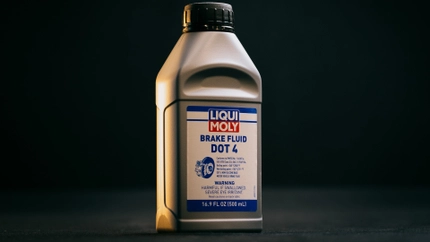
This is the most common type of fluid in use today. It came to popularity in the early aughts and is the best choice for most sedans, SUVs of all performance types, and sports cars. The color is always light amber, but you may see references to a light blue fluid commonly used elsewhere. Although no longer allowed in the US, its coloring is the only significant difference to our DOT4, so it can be used interchangeably.
Minimum Dry Boiling Point: 446°F
Minimum Wet Boiling Point: 311°F
Composition: Glycol Ether/Borate Ester
Replacement Interval: Two years
Color: Pale Amber
DOT5 Brake Fluid*
Standing alone in the realm of brake fluid formulas is the Silicone-based DOT5. Although still around, it’s a hardly-used type, with classic cars and motorcycles as the primary users. Differences from Glycol-based fluid include better resistance to boiling and the inability to absorb water. That last point makes it an excellent choice for vehicles sitting around for extended periods. However, it comes at the cost of pedal feel. *We don’t sell DOT5 at FCP Euro.
Minimum Dry Boiling Point: 500°F
Minimum Wet Boiling Point: 356°F
Composition: Silicone
Replacement Interval: Until discolored
Color: Purple
DOT5.1 Brake Fluid
This is a polyethylene-glycol-based fluid like DOT4 and DOT3 that meets the same boiling point standards as DOT5. It’s backward compatible with all brake systems that use a standard fluid type.
Minimum Dry Boiling Point: 500°F
Minimum Wet Boiling Point: 356°F
Composition: Glycol Ether/Borate Ester
Replacement Interval: Two years
Color: Pale Amber
DOT4 Low Viscosity & DOT4+ Brake Fluid
Because of DOT4’s popularity and slight individual differences between manufacturers, there have been a few offshoots from the standard. Low viscosity DOT4 is a thinner fluid that performs best in vehicles that use the brake system to assist with stability control and other active systems. Typically, they’re denoted by an “LV” or “SL.6” label. Most will also have higher boiling points to survive the extra strain of TCS and ESP systems. It’s been the standard in Audi and VW vehicles since 2006 and in BMWs since 2002.
Super DOT4 or DOT4+ is a DOT4 blend rated at a much higher temperature than the engineering requirements for the standard DOT4 certification. It’s the best brake fluid if you’re heading to the track or seeing regular spirited driving with intensive braking. Exact boiling points vary between formulas and manufacturers, so we’ve compiled a list of what we offer for your viewing pleasure.
| Fluid Name | Dry Boiling Point | Wet Boiling Point | Link To Product |
| Motul RBF 660(Track) | 325 °C (617 °F) | 204 °C (400 °F) | MOTUL RBF 660 |
| Castrol React SRF(Track) | 320 °C (608 °F) | 270°C (518°F) | Castrol React SRF |
| Motul RBF 600(Track/AutoX) | 312 °C (594 °F) | 216 °C (421 °F) | MOTUL RBF 600 |
| ATE Type 200(Daily/AutoX/Light Track) | 280 °C (536 °F) | 198 °C (388 °F) | ATE Type 200 |
| BMW Brake Fluid(Daily) | 265 °C (509 °F) | 170 °C (338 °F) | BMW Brake Fluid |
| ATE SL.6(Low Viscosity) (Daily) | 265 °C (509 °F) | 175 °C (347 °F) | ATE SL.6 |
| Titan DOT 514 LV(Daily) | 265 °C (509 °F) | 170 °C (338 °F) | Titan DOT 514 LV |
Automakers that call for LV fluid from the factory:
- Audi (2006 on)
- BMW (7/2002 on)
- MINI (all years)
- Saab (all years)
- Volkswagen (2006 on)
Automakers that call for regular non-LV fluid from the factory:
- Audi (up to 2005)
- BMW (up to 6/2002)
- Jaguar (all years)
- Land Rover (all years)
- Porsche (all years)
- Volvo (all years)
- Volkswagen (up to 2005)
Again, DOT 3, DOT 4, and DOT 5.1 brake fluids can be substituted, but must be flushed completely. It all depends on your driving habits and the car's use.
What Brake Fluid Should I Run For The Race Track?
If you are tracking your vehicle or if it sees performance events, we have higher-capacity fluids available. These fluids work better and longer under high stress and high loads. It is suggested to replace the fluid once it overheats and begins to fade or once every 90 days. Most sanctioning bodies that hold events require at most 90 days since the brake fluid was changed prior to participating. One of the most recommended racing brake fluids that we sell is ATE TYP 200.
What Happens When Your Brake Fluid Is Low?
Low brake fluid should be cause for concern if it hasn’t been serviced recently. It doesn’t evaporate at any kind of rapid rate, especially when the master cylinder cap seal is tight and healthy. Generally, it’s a sign of a leak somewhere in the system and is likely matched with a soft brake pedal. If not, the fluid could be low and need a top-off.
Brake fluid is highly caustic and will strip the paint from any surface it’s left on. Take caution when refilling the reservoir using a funnel, or have rags ready to sop up any spillage. Also, ensure you’re using the correct fluid for your application by reading the master cylinder cap. It’ll tell you which fluid is OE, and while not the only one that’ll work, we recommend replacing it with one as close as possible.
Once it’s topped up, look around the car for any leaks. You really cannot be too careful regarding your braking system. Having the car up on jack stands for a few days while you wait for a new brake hose to come in is much better than watching a flatbed tow it away as you peer through the open rear doors of an ambulance.
Brake Fluid Service Recommendations
Yes, these are recommendations, but we strongly suggest you follow them.
The standard replacement interval is around 30,000 miles or every two years. That applies to all daily drivers and those who see the occasional backroad blast. Infrequent auto-crossers can also fall under that recommendation, depending on how often the middle pedal is abused per session. Anyone with more aggressive fluid and regular on-track driving will want a much shorter interval. You should check your fluid between events and replace it once it has discolored. Doing so can be an unforeseen expense, but clean and healthy fluid will always provide a firmer pedal with better feedback, and that’s invaluable when slowing down from triple-digit speeds.
How To Check Your Brake Fluid Level & Health
Checking your brake fluid level is one of the more manageable tasks for an owner. Brake fluid reservoirs are always transparent, so the easiest way to check is by looking at them. That can be easier said than done for some, as manufacturers, not limited to BMW, like to shove them under a plastic cowl. That said, all that should take is removing some clips for access. Once you’re there, fluid level markers will be cast into the side of the reservoir, or a dipstick will be attached inside the cap.
Check the level before anything else, but carefully examine the fluid. It should be a light amber color or similar. Anything resembling a hearty-brewed tea is bad for your brake system and should be flushed with fresh fluid immediately. Of course, you can always test it with some technology if that's not certain enough.
OTC offers a DOT4 brake fluid testing pen that eliminates the guesswork of checking fluid. Simply remove the cap, stick the two prongs into the fluid, and hit the button. The pen then analyzes the moisture content and gives you the moisture content within 1% of actual.