- 07/14/2025
- 3 Min Read
- By: Christian Schaefer
Audi quattro with Ultra Technology: A New Era For Audi's Most Famous Feature

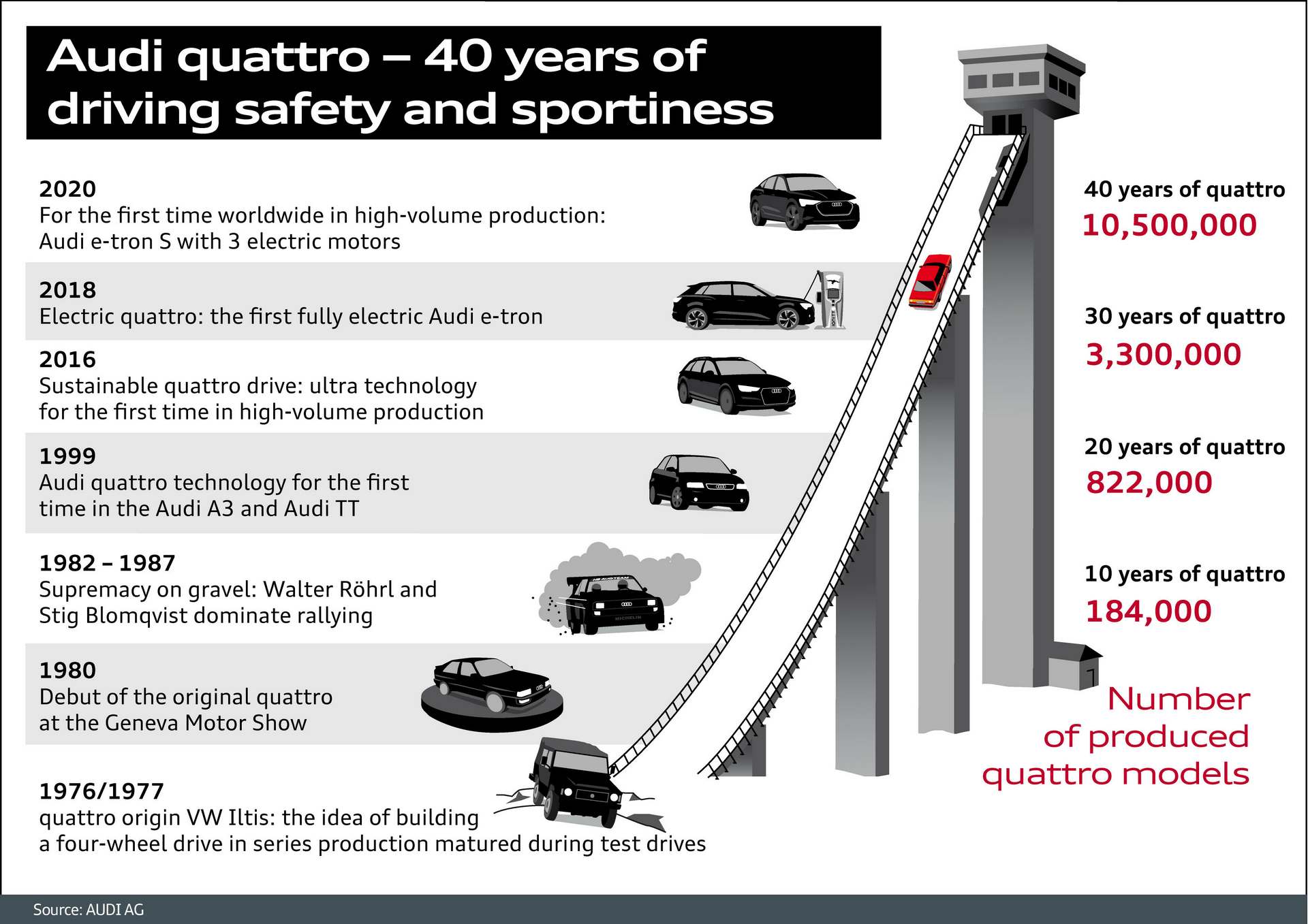
Quattro all-wheel drive has been the backbone of Audi’s brand for four decades. Being the first to market with full-time all-wheel-drive was a big deal in the day, and the four rings have become synonymous with it ever since. Traditionally, ‘true’ quattro has always been a longitudinal drivetrain arrangement with a TorSen center differential splitting power to both axles, but the push for efficiency has made it obsolete. A decade ago, Audi debuted ‘quattro with Ultra technology’ in its most efficient models, but now it's universal across the entire line-up. Audi quattro has changed, and it might actually be for the better.
What Is Audi Ultra?
Look around Audi’s lineup and recent tech advancements, and you’ll notice the Ultra badge in a handful of places—it’s been around for a while, now. In short, it’s Audi’s terminology for any tech or feature designed to reduce emissions and fuel consumption. Badge prominence ranges from being included as a specific model designation for A3, A4, A5, and A6-based models from this current era in the US, to specific technologies themselves, like the newest iteration of quattro AWD.
In the case of the models given the Ultra badge, there’s more to it than a different quattro. Key to their designation is a different engine from the non-Ultra variants. Most often, it’s the EA888.3b—a highly-revised version of VAG’s bulletproof turbocharged 2.0L four-cylinder engine. With a wildly different cylinder head, a smaller turbocharger, and a modified Miller-cycle combustion process, it’s quite a bit more efficient than the engine with which it shares most of its designation. However, the efficiency-focused tech isn’t just for the Ultra-badged models anymore. You can now find it in almost every small and midsize model.
Quattro with Ultra Technology
Automakers attempting to evolve or revolutionize a beloved product have one of the hardest jobs in the world. Moving the C63 to a turbo four-cylinder hybrid powertrain or the 911 from 993 to fried-egg 996 were moves made to bring the respective models forward, but resulted in outcries from enthusiasts as near blasphemous. The quattro badge has a similar following and respect from enthusiasts, so it’d be easy to assume Audi faithful would react similarly enough to force Audi to move backward and bring back the quattro of old. But that hasn’t happened.
Audi seemingly understood quattro's reputation and ensured their newest version kept that intact. If anything, Audi has made it more versatile for daily commutes and performance situations. That’s not exactly common for the technologies and models we love, which are further refined in the name of efficiency and economy.
Audi engineers essentially switched it from all-wheel drive to four-wheel drive, but rather than using a manual lock-up, computers are involved. The system primarily operates in all-wheel drive, like from a stop or in hard cornering, but in regular driving, the rear end decouples, and torque is exclusively sent to the front wheels. Only when the system believes extra traction is needed is the all-wheel drive portion reengaged. Think GM’s Displacement on Demand cylinder deactivation, but for the drivetrain.
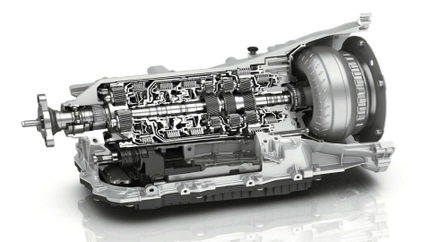
In place of the traditional TorSen center differential is an electro-mechanical differential with wet clutches to disconnect the drive shaft from the front wheels and gearbox. Two clutches in the rear differential—one for each axle shaft—disconnect the drive shaft and differential from the rear wheels, eliminating any parasitic drag from having to keep them rotating.
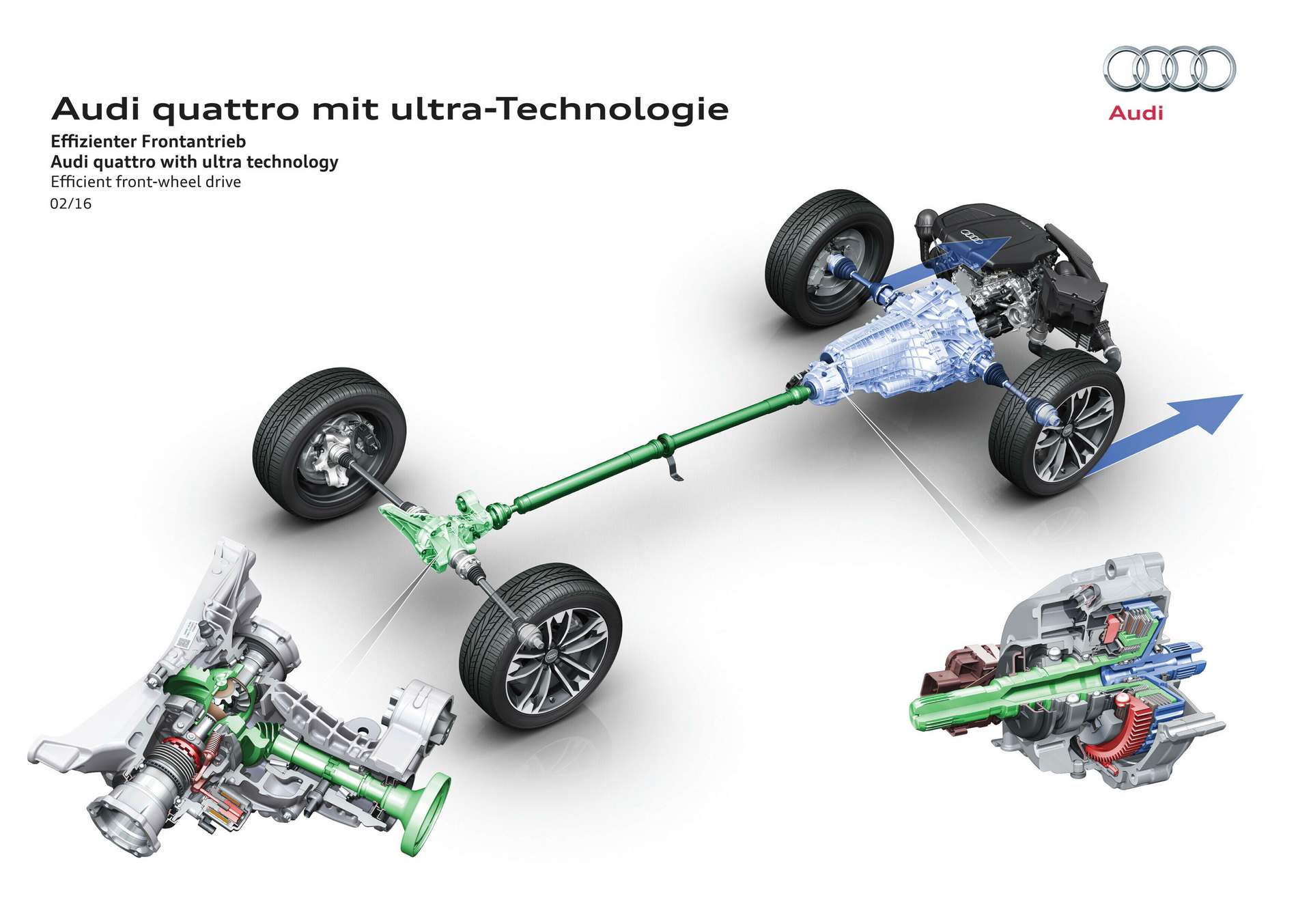
The computer system uses sensors and cameras around the car to determine when to engage the rear axle. These sensors read just about every parameter possible while scanning the road ahead. Other factors like driving style, ESC activation, and the drive mode selected play into the calculations, which happen in a three-stage strategy, according to Audi. Those three stages are proactive, predictive, and reactive.
Wheel speed, steering angle, and roll sensors help with the proactive stage, activating the rear based on pre-calculated grip limits based on the known limits. The predictive uses the drive’s selected settings to predict the kind of driving behavior that’s coming and the level of grip it’ll need. In switching from Comfort to Dynamic mode, power is sent to the rear axle sooner and in a greater percentage, improving the driving dynamics, particularly at low friction coefficients. For the driver, that appears as the ability for on-throttle oversteer. The reactive stage only activates when a change in the coefficient of friction is sensed. All of that together results in a system that runs simulations every ten milliseconds about what kind of grip will be needed in the next half-second of driving ahead.
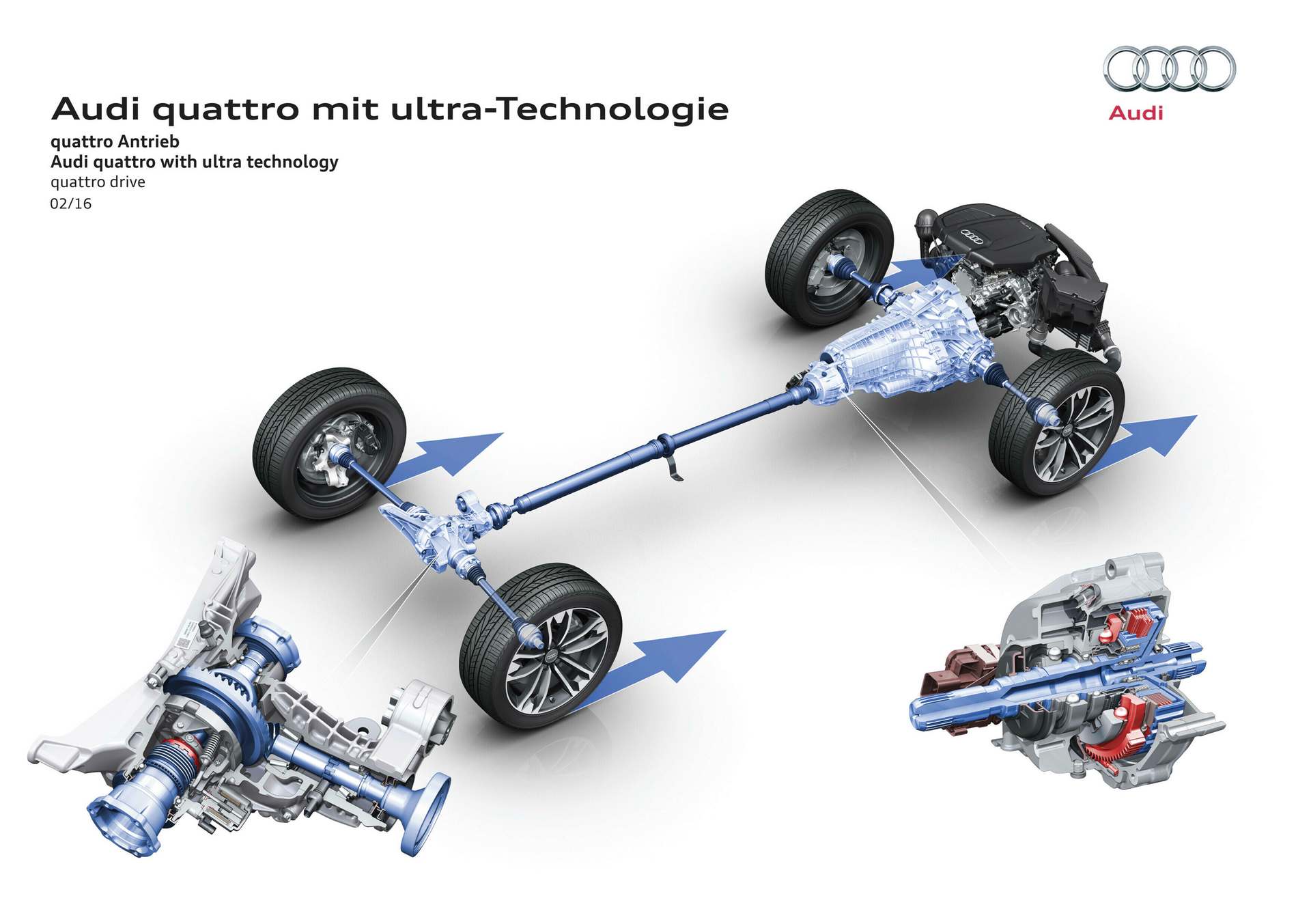
It’s the culmination of a handful of well-proven systems like the Haldex AWD and sports differential, though this time they’re together for efficiency purposes on a longitudinal drivetrain. Audi maintains that this system is as good, if not better than, the outgoing and “traditional” quattro, but owners and Audi faithful remain mixed. Not so much on the outright performance, but on the update's complexity and almost sacrilegious nature. The latter is purely subjective, but the former has caused the ire of more than a few owners thanks to some teething issues with the various coupling components.
However, as Audi fits it to more models, reliability should improve, or so we can at least hope. VAG’s all-wheel drive systems have been very solid, historically, and while not perfect, enthusiasts are quick to stand by them. If Audi has done their homework, quattro with Ultra technology should be the same.
The Future of Audi quattro
Whether you like it or not, quattro Ultra is here to stay. It’s not exactly new—we first received it in the 2017 B9 A4 allroad, before it was followed by the Q5, A6, and A7—so there’s a good chance you’ve seen plenty of it without noticing, and now it’s in the freshly debuted B10 A5 models. One can only imagine that more models will be coming in the future, but for now, Audi is still producing quattro in the traditional sense.
The B10 S5 is confirmed to use a TorSen center differential and an S Sport rear differential, and the D5 A8 remains a less performance-oriented version of the same thing. We can only imagine the newest S8 will follow with something akin to its predecessor. The big SUVs in the Q7 and Q8 also retain their transfer case “quattro” AWD systems, and the smaller MQB-based models retain the Haldex-esque transverse quattro. That should give anyone plenty of options to find something without the Ultra technology, should they not want it.
At the very least, we can appreciate that AWD hasn't been removed entirely from smaller vehicles in the name of efficiency. Weight and parasitic losses are the enemy of the efficiency we’re so desperately after these days, and almost every aspect of AWD systems makes that much more challenging. Quattro with Ultra tech is the perfect example of how far some are going to keep it around. Even better, regardless of which quattro variant your Audi has, you can be sure you’ll find the parts you need to keep it healthy here at FCP Euro. Shop now and take advantage of our catalog experts who’ve assembled a comprehensive parts supply for every Audi built in the last thirty years.