- 07/28/2014
- 1 Min Read
- By: Dan Bullmore
The Science of Comfort: How Air Conditioning Works

At my home in Houston, Texas, there is no single factor more critical to quality of life than air conditioning. Although that might seem like a stretch, many of you know what it means to go without when it's 100 degrees out- or worse, when it's 100 degrees out at 80% humidity... That's when we either breathe a sigh of relief and turn on our A/C, or breath a sigh of despair and roll down the windows.
A/C is easier than you might think
Despite what you might think, air conditioning is not a complicated system, and in fact the science behind it may be even simpler. It just so happens that most of those things we take for granted are so simple, we never stop to think of how they actually work (take the toilet, for example). We know from life experience that when we spray an aerosol can, the can will become uncomfortably cold in just a few seconds. This is because expansion from high to low pressure causes a rapid absorption of heat energy from the material's environment. As the gas expands from the high pressure can into the low pressure atmosphere, it draws in heat energy in the process, leaving a decreased amount of heat energy in the can, and thus, in your hand.
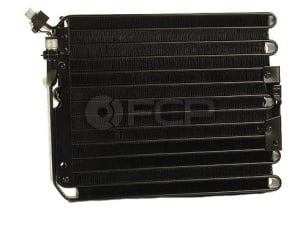 A/C Condenser
Indeed, our air conditioning works in pretty much the exact same way. A refrigerant moves in tubes between two heat exchangers (radiator-like devices), one on the inside of the car, and one on the outside. The inside one (evaporator) exchanges the cabin heat to the refrigerant, and the outside one (condenser, pictured below) rejects that heat to the outside of the car. The magic happens at the expansion valve (or orifice tube, depending on your car).
A/C doesn't blow cold air into the car
The compressor sucks down the refrigerant in the evaporator which causes a low pressure area inside. On the other side of the evaporator is the expansion valve which closes off to a certain degree to maintain the pressure drop. When the refrigerant passes through the restriction and into the low pressure evaporator, it evaporates and takes on heat energy from inside of the cabin. Thus, we can see that the air conditioning doesn't blow cold air into the car. It sucks the heat out of the car, and blows the left over air out of the vents.
The compressor then takes this refrigerant, compresses it, and blasts it out of the high pressure side, where the refrigerant is pushed into the condenser. In the condenser, the heat is rejected to the outside of the car by the cooling fans. The cooled refrigerant condenses, and returns to the evaporator as a liquid ready to be sucked through the expansion valve to start the process over.
In between the condenser and the evaporator, the refrigerant moves as a liquid and passes through the receiver/dryer where it is, quite literally, received and dried. Any moisture in the refrigerant, either from a leak or from improper charging will be absorbed by the receiver/dryer's desiccant pack. If this gets too filled with moisture or debris, it can impede the coolant flow and will need to be replaced. The receiver/dryer should be replaced any time the system is opened so that the moisture can be controlled inside the system. This is because water vapor evaporates at a different rate than the refrigerant and can cause the cooling system to cool improperly, or worse, rust.
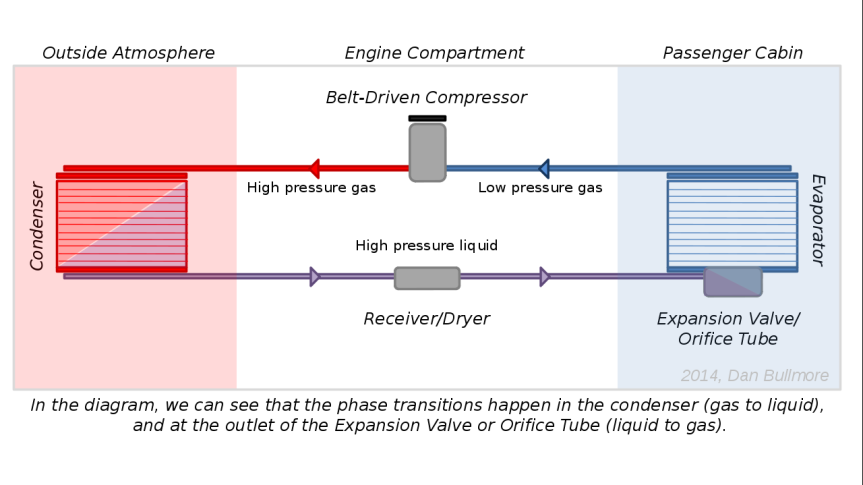
As you can see, the function of the air conditioning is really quite simple when we discuss the basic physics of it. There are, or course, numerous sensors, switches, clutches, regulators, and controllers, but rest assured that all of those parts exist solely to support the function described above- it really is just this simple!
 Dan Bullmore is a physicist and engineer from Houston, TX. Preferring the old to the new, Dan has owned many examples of Mercedes and Volvos and has devoted much of his time to maintaining and understanding them.