A funky smell can come from a number of areas on the interior of your car. It could be from a previous owner's dog or cat, items dropped or spilled in the HVAC (Heating Ventilation Air Conditioning) , cigarette/cigar smoke, garbage hidden away under the seats, previous water damage/flooding, rodent nests, unfortunate accidents involving… uh… bodily fluids of all kinds. The list can go on and on, and gets more and more stomach wrenching. But how does one track down and eliminate a smell for good?
Find and eliminate the cause
As always, lets start with the simplest approach. Give your interior a good cleaning. Vacuum it out, clean and condition any leather or vinyl, poke around in all the cracks and crevices and don’t ignore the headliner or the windows. I’ve used a few different cloth interior cleaning products where you spray a foam on and scrub it in, they seemed to work pretty well at removing stains and dirt. While you’re doing it pay attention to what your nose is telling you. Get the car up to operating temperature and turn the heat on high and smell the air coming through. We’re trying to find and eliminate the cause of the smell here, so if anything seems fishy, investigate further.
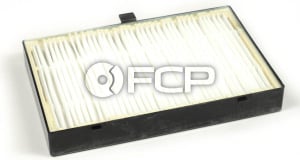 Look over the back-end of the HVAC system
If you’ve still not found the foul smelling source then move on to more advanced measures. Now would be a good time to replace your cabin air filter, this is a common item that is neglected by many but it’s easy to replace and will give you a chance to look over the back end of the HVAC system. Rear seats in modern cars are typically fairly easy to remove, at least the seat bottoms where things can collect under them. The front seats can also be removed if you’re having problems cleaning under them. Ensure that the battery has been disconnected if you’ve got side airbags and use any method you’re comfortable with to ensure any charge has been drained (many suggest waiting a period of time) Many cars are different, but you’ll usually find a number of bolts holding the seats to the floor. With the front seats out, lay down on the floor with your head under the dashboard and look up underneath. Removal of lower dashboard covers may be required. You’re looking for rodent nests or droppings that will lead to the cause.
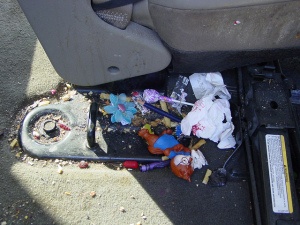 If the smell is still there and you’ve had no luck thus far, you may be compelled to strip the interior. Start with the battery precaution from Phase II and remove the seats, then any plastic trim or panels and the center console, finally pull out the headliner and the carpeting. Once out you should shampoo the carpet, ensuring enough time to fully dry. The headliner may not hold up as well to a shampoo, but give it a good vacuuming. This Phase is a daunting task, breaking clips and plastic is a very real possibility, so take your time. It’ll be a shame if you break clips that result in painful squeaks and rattles in the future. If needed, make a trip to a local U-pull salvage yard that has the same make/model as you, practice removing the interior panels and get a feel for what’s involved.
Mold is serious and can cause significant health problems
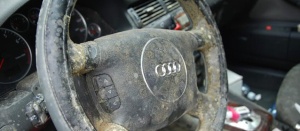 If you’ve found the smell to be mold, it was likely caused by old food or water damage. You can do your best to remove the carpet or seat upholstery and shampoo it, but you may be faced with the only option of replacing the effected items altogether. Mold is serious and can cause significant health problems.
Get rid of lingering molecules, bacteria...
The finishing touch. This should be done at the end after you’ve located and stopped the cause of the odor, regardless of how many phases you’ve had to suffer through. The idea is to get rid of any lingering molecules, bacteria, or spores floating around in there. The best option for this Phase is to get your hands on an Ozone machine, this is a machine that pumps out O3 molecules. The 3rd Oxygen atom is unstable and will detach from the O3 molecule and attach to the foreign substance killing it and it’s smell. An alternative to a fairly expensive Ozone machine is an Ozone spray, you can find this in many stores. Or, if you’re a fan of trying new things, you can build your own Ozone generator at your own risk. Regardless of your method, Ozone is not good to be around too much so you should set it up in a closed area and leave it to do its work.
Shop Volvo Climate Control at FCP Euro
About the Author: Glen Cordle
 Glen is a mechanical designer from Minneapolis Minnesota. An old-school motorhead at heart, he respects anything that's had passion poured into it. A jack of all trades, master of some.