- 04/03/2026
- 2 Min Read
- By: Christian Schaefer
Dinan's Engineers Show Us What It Takes To Make A Great Performance Exhaust

What separates the best tuners from the rest? Any quick Google search will show you that “performance” upgrades aren’t hard to find, with lots of parts made overseas promising all the benefits you’re after. They exist because of inexpensive manufacturing, but no cost or lack thereof could account for the hundreds of hours it takes companies like Dinan to properly engineer a product that not only performs well, but lasts a long time, fits properly, and slots into a vehicle’s powertrain or suspension like it was always meant to be there. Dinan’s nearly fifty years of enhancing Bavaria’s best have been built on a blend of motorsport experience and a drive to craft the best product right down to the last bead of weld, resulting in world-class products that bring genuine results. I couldn’t blame you if you didn’t know what that looks like, because few do, but a recent partnership for our BMW X3 M40i build gave us the chance to tour their main facility and highlight exactly what sets Dinan above the rest.
Down in Opelika (Oh-puh-like-a, apparently), Alabama, you won’t find just Dinan, but APR, an American tuner focusing on the Volkswagen umbrella. The two companies are, figuratively and literally, under one roof, sharing a building, a parent company, and engineering and manufacturing resources. They may serve opposing customer bases, but the brains and hands behind the parts are dedicated only toward creating aftermarket performance parts worthy of factory approval and EPA compliance.
Engineering mostly air-intake components, exhaust systems, and engine software, the core challenge is often finding a way to stay within emissions limits and noise constraints while making more power. One bend too sharp, one filter too long, one degree of ignition timing too little, and they may have to start over. The number of factors to consider across those three distinct product areas is enough to make anyone’s head spin, but to Dinan engineers, it’s just another day at the office.
Getting The Right Exhaust Sound Takes Special Equipment
Take, for example, the process of developing an exhaust system. Where does that start? Surely getting an idea of its required shape for proper fitment, yeah? Nope. It’s getting the most intimate and scientific data on the original exhaust system, gathered by several microphones and binaural recording devices placed throughout the vehicle. Audio is recorded at several points in the cabin and exterior to find the specific resonance frequency that the automaker has engineered for and to avoid.
If you’ve had the displeasure of installing a cheaper aftermarket exhaust from a somewhat avoided brand, you’re more than likely familiar with the drone it can create at cruising speeds. Droning occurs when the engine's exhaust resonance frequency matches the muffler's, leading to a boomy, low-frequency noise. Automakers are well aware of the issue and design their exhausts around it. Utilizing the audio data, Dinan/APR does the same, ensuring you’re not sacrificing comfort for your extra sound and performance.
Following the audio data, the vehicle in question is brought back to the shop, where it’s put on a lift and 3D-scanned to give CAD designers an exact digital model to build around. Before long, a prototype is whipped up on the fab table and then test-fitted to the vehicle. In theory, they could leave the design as is and sell it as an “upgrade,” so long as it fits, like some other companies would, but Dinan instead will put a new system through several rounds of road testing.
Although the audio testing on the stock vehicle influences the initial prototype muffler, it leaves an incomplete picture. Other data points, like back pressure and temperature, are just as important at this point and are tracked during testing. Back pressure is a major performance factor, influencing exhaust scavenging and power output, but heat management can really make or break the muffler, as Phil Munoz, Dinan/APR’s Lead Vehicle Technician, experienced firsthand while developing a performance exhaust for the BMW G01 X3 M40i.
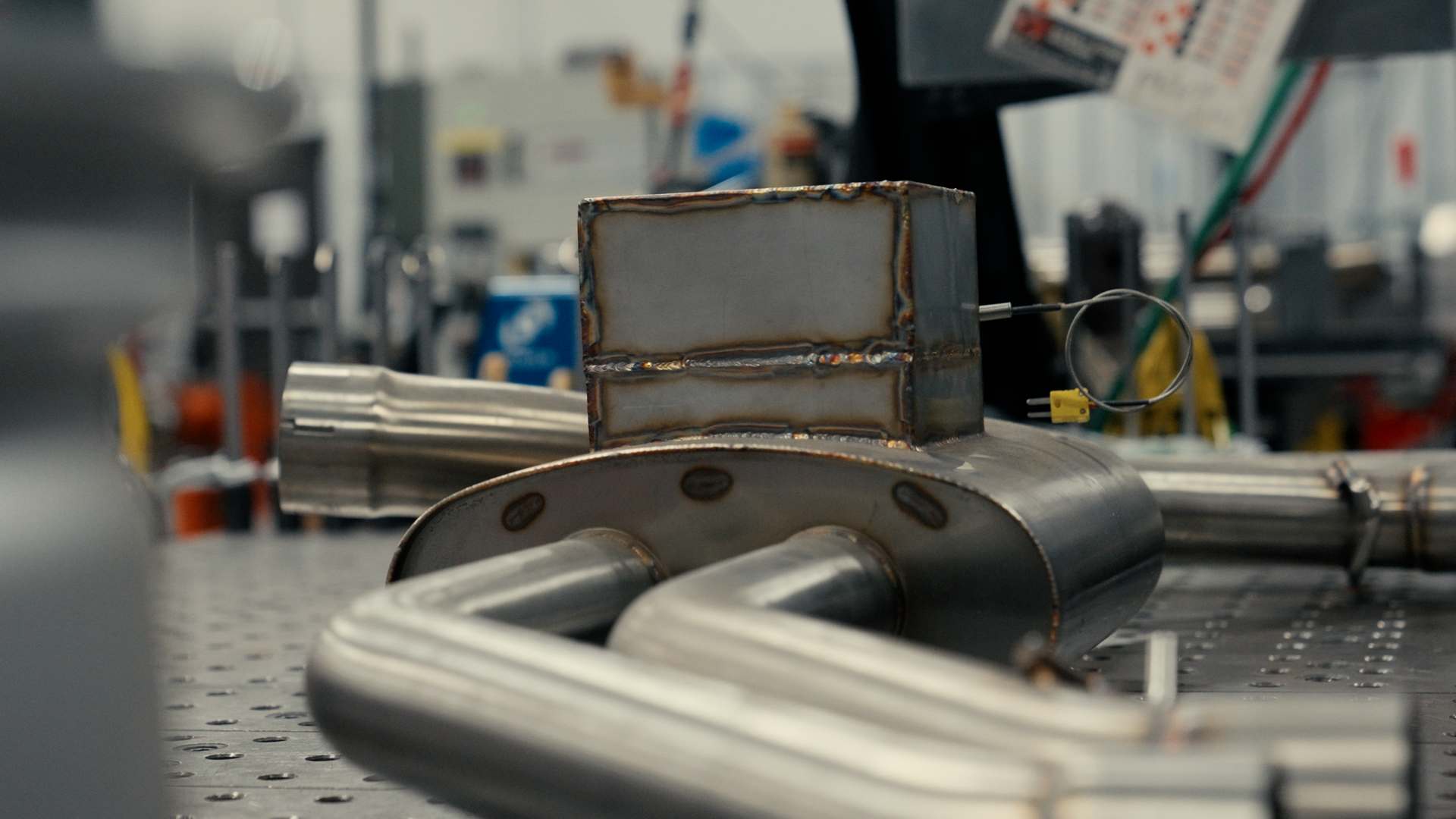
A trip to Atlanta with the prototype exhaust exposed a drone that worsened as the drive went on, so on went the temperature and audio testing equipment for an extended drive period. It revealed that a lack of volume in the muffler can was causing heat to build up. In the same way heat expands metal, it increases the Helmholtz frequency of a given object, and the heat build-up in the muffler was enough to raise the muffler's frequency, causing the gradually worsening drone. Luckily, finding the cause of the issue was the hard part; resolving the drone required only adding volume to the muffler can.
Regardless of how many revisions the prototype system sees, it must pass a final fitment check to finalize bracketry and clamp locations before it’s cleared for production. Other products, like air intakes and software tuning, spend time on the flow bench and in a dyno cell with a 5-gas analyzer, ensuring performance gains are strong enough, safe for surrounding hardware, and compliant with emissions standards. Regardless of what Dian/APR is creating, the entire process is fascinating, with passionate people at every level. Unfortunately, all you really ever see is the precision machining and welds worthy of a pin-up magazine on final products. Or at least that was the case until we were allowed to film our tour and bring it directly to you. Do yourself a favor and check it out, if not for the products, for the passionate people who bust their brains and knuckles every day to keep aftermarket tuning and performance alive in an ever-restrictive world.